
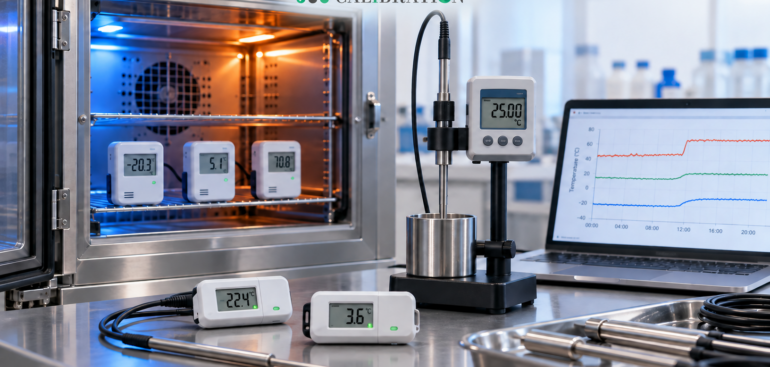
Accurate temperature monitoring is essential for businesses that store, manufacture, transport, or test temperature-sensitive products. Data loggers are commonly used to record temperature conditions over time and provide evidence that products, equipment, and controlled environments have remained within acceptable limits.
However, the information recorded by a data logger is only useful when the device measures temperature accurately.
Regular data logger calibration helps identify measurement errors, confirm instrument performance, and provide greater confidence in recorded temperature data. Without appropriate calibration, an inaccurate data logger may produce misleading results and expose a business to quality, safety, compliance, and operational risks.
<h2>What Is a Temperature Data Logger? </h2>
A temperature data logger is an electronic instrument that measures and records temperature at predetermined intervals.
Unlike a standard thermometer, which generally displays the current temperature, a data logger creates a historical record. This allows users to review temperature changes over several hours, days, weeks, or months.
Depending on the model and application, a data logger may include:
- An internal temperature sensor
- An external temperature probe
- A digital display
- Data storage
- Alarm functions
- USB connectivity
- Wireless communication
- Cloud-based monitoring
- Reporting and analysis software
Temperature data loggers are used in storage rooms, refrigerators, freezers, laboratories, warehouses, manufacturing facilities, vehicles, shipping containers, and other controlled environments.
Why Is Data Logger Calibration Important?
Data logger calibration compares the measurements produced by a logger with those from an appropriate reference standard under controlled conditions.
The process helps determine whether the instrument is measuring within the required tolerance.
Over time, temperature sensors can develop measurement drift because of ageing, repeated use, physical damage, environmental exposure, battery problems, or changes in electronic components.
A data logger may continue producing readings even when those readings are no longer sufficiently accurate.
Calibration helps identify this difference before it creates a significant problem.
Key Benefits:
- Improved Accuracy: Calibration verifies whether the data logger provides temperature measurements within the required specifications.
- Reliable Temperature Records: Accurate measurements improve confidence in the temperature history recorded for products, equipment, and controlled environments.
- Quality Assurance: Calibrated data loggers support quality-control procedures and help businesses maintain consistent operating conditions.
- Compliance Support: Calibration certificates and organised records can support audits, internal procedures, and applicable industry requirements.
- Reduced Product Risk: Identifying inaccurate monitoring equipment may help prevent temperature-sensitive products from being stored or transported under unsuitable conditions.
- Early Fault Detection: Calibration can reveal measurement drift or instrument problems before complete failure occurs.
How Inaccurate Data Loggers Affect Temperature Monitoring
An inaccurate data logger may show that temperatures remained within the required range when the actual conditions were too high or too low.
It may also produce false alarms even when the environment is operating correctly.
These incorrect readings can lead to:
- Product quality problems
- Unnecessary product disposal
- Missed temperature excursions
- Incorrect operational decisions
- Delayed investigations
- Failed quality checks
- Audit difficulties
- Increased business costs
For example, a refrigerated storage area may need to remain within a specified temperature range. If the data logger reads lower than the actual temperature, staff may believe the products are being stored correctly even though the environment is too warm.
Regular calibration helps businesses detect these measurement differences.
Industries That Depend on Calibrated Data Loggers
Many industries rely on continuous and accurate temperature monitoring.
Some important sectors include:
- Pharmaceutical and Healthcare: Medicines, vaccines, biological materials, and other temperature-sensitive healthcare products require appropriate monitoring during storage and transportation.
- Food and Beverage: Food manufacturers, cold-storage facilities, supermarkets, restaurants, and transport companies use data loggers to monitor refrigerated and frozen products.
- Laboratories: Research, testing, environmental, and calibration laboratories depend on controlled conditions for equipment, samples, and testing processes.
- Manufacturing: Industrial processes may require temperature monitoring to maintain product quality, production consistency, and equipment performance.
- Warehousing and Logistics: Warehouses, refrigerated vehicles, shipping containers, and distribution centres use data loggers to monitor conditions throughout the supply chain.
- Agriculture: Agricultural and horticultural businesses may monitor temperature during production, storage, transport, and processing.
- Museums and Archives: Temperature monitoring helps organisations protect historical records, artworks, and sensitive materials.
- Data Centres and Technology Facilities: Data loggers can support environmental monitoring around servers, electrical equipment, and temperature-sensitive technology.
Types of Data Logger Calibration
The appropriate calibration method depends on the data logger, sensor type, operating range, accuracy requirement, and intended application.
1. Single-Point Calibration
Single-point calibration checks the data logger at one selected temperature.
This may be suitable when the logger is used around one stable operating temperature. However, it may not provide enough information for applications that cover a wider temperature range.
2. Multi-Point Calibration
Multi-point calibration checks the logger at several temperatures across its operating range.
For example, a logger may be checked at low, medium, and high temperatures. This provides a broader understanding of its performance and can help identify whether measurement errors change across the range.
3. Laboratory Calibration
Laboratory calibration is performed in a controlled environment using suitable reference equipment and established procedures.
This approach is commonly used when stable conditions, specific calibration points, or more detailed testing are required.
4. On-Site Calibration
Where suitable, on-site calibration can be performed at the customer’s facility.
On-site services may help reduce equipment transportation, monitoring interruptions, and operational downtime. Suitability depends on the instrument, required temperature points, environment, and available calibration equipment.
What Happens During Data Logger Calibration?
During calibration, the data logger is exposed to controlled temperature conditions and its readings are compared with those from an appropriate reference standard.
A typical process may include:
- Inspecting the data logger and sensor
- Confirming the required temperature range
- Selecting appropriate calibration points
- Allowing the logger and reference instrument to stabilise
- Recording the measurements from both instruments
- Calculating the difference between the readings
- Determining whether the logger performs within the required tolerance
- Documenting the calibration results
- Adjusting the logger where possible and authorised
- Issuing appropriate calibration documentation
The exact process can vary depending on the data logger, calibration method, service provider, and customer requirements.
Why Calibration Records Matter
Calibration records provide documented evidence of an instrument’s performance at the time it was tested.
An appropriate calibration certificate may include:
- Instrument identification
- Manufacturer and model
- Serial number
- Calibration date
- Temperature test points
- Reference readings
- Data logger readings
- Measurement differences
- Environmental conditions
- Reference equipment used
- Traceability information
- Calibration results
- Recommended recalibration date
Businesses should store calibration records in an organised equipment-management system.
These records may support internal quality procedures, equipment histories, audits, investigations, and future calibration planning.
How Often Should Data Loggers Be Calibrated?
There is no single calibration interval suitable for every data logger.
The appropriate interval depends on factors such as:
- Manufacturer recommendations
- Frequency of use
- Required measurement accuracy
- Operating environment
- Temperature range
- Sensor stability
- Previous calibration results
- Industry requirements
- Internal quality procedures
- Importance of the monitored product or process
Many businesses establish a regular calibration schedule and then review it according to the instrument’s performance history.
A shorter interval may be appropriate when:
- The data logger is used continuously
- Measurements are critical to product quality
- The instrument operates in harsh conditions
- Previous results show measurement drift
- The logger has been dropped or damaged
- A monitoring result appears unusual
- The device has undergone repair
Calibration should also be considered after events that may affect the instrument’s performance.
Calibration vs. Validation: What Is the Difference?
Calibration and validation are related but different activities.
Calibration evaluates the accuracy of the measuring instrument by comparing it with an appropriate reference standard.
Validation provides documented evidence that a process, system, storage area, or monitoring arrangement performs as intended under defined conditions.
For example, calibrating the data logger confirms whether the device measures temperature accurately. Validating a refrigerator or warehouse may involve evaluating whether the entire environment consistently maintains the required temperature range.
Accurate, calibrated data loggers can provide important information during validation activities.
Choosing a Data Logger Calibration Provider
Selecting the right calibration provider is important for businesses that depend on accurate temperature records.
Consider the following factors:
- Technical Experience: Choose a provider with appropriate knowledge of temperature data loggers and sensor systems.
- Suitable Temperature Range: Confirm that the provider can calibrate the logger at the temperatures required for its application.
- Calibration Documentation: Check whether the service includes clear and appropriate calibration certificates.
- Measurement Traceability: Confirm that the provider can offer the level of measurement traceability required by your organisation.
- Laboratory and On-Site Options: Determine whether the service can be performed in a laboratory or at your facility.
- Turnaround Time: Consider how long the data logger will be unavailable and whether replacement monitoring arrangements are needed.
- Instrument Coverage: A provider that calibrates different logger brands, sensor types, and related temperature equipment may simplify equipment management.
How Data Logger Calibration Supports Cold-Chain Monitoring
Cold-chain monitoring involves maintaining suitable temperature conditions while products move through storage and transportation.
Data loggers may be used in:
- Refrigerated warehouses
- Cold rooms
- Freezers
- Medical refrigerators
- Delivery vehicles
- Shipping containers
- Insulated transport packaging
- Distribution centres
Calibrated data loggers help businesses produce more reliable records of the conditions experienced by temperature-sensitive products.
If a temperature excursion occurs, accurate records can support investigations and decisions about product quality.
An uncalibrated or inaccurate logger may make it difficult to determine whether the recorded excursion was real or caused by measurement error.
Common Signs That a Data Logger May Need Calibration
A data logger may require calibration or technical inspection if:
- Its readings differ from another trusted instrument
- It produces unexpected temperature changes
- Recorded values remain unusually constant
- Alarms activate without a clear reason
- The sensor has been damaged
- The logger has been dropped
- The device was exposed outside its intended range
- The battery has been replaced after a long period
- Its calibration date has expired
- Previous calibration results showed significant drift
Suspicious readings should be investigated rather than automatically accepted.
How Australian Businesses Can Manage Data Logger Calibration
An organised calibration program can help Australian businesses manage their monitoring equipment effectively.
A practical system may include:
- Assigning a unique identification number to every logger
- Recording the make, model, and serial number
- Documenting where each logger is used
- Setting a suitable calibration interval
- Maintaining calibration certificates
- Recording repairs and adjustments
- Reviewing historical calibration results
- Setting reminders before calibration becomes due
- Providing backup loggers during servicing
- Investigating failed or out-of-tolerance results
A central equipment register can help prevent loggers from continuing to operate after their calibration due dates.
The Future of Temperature Data Logger Calibration
Temperature-monitoring systems are continuing to develop.
Modern data loggers may include wireless sensors, cloud connectivity, real-time alarms, automated reporting, and integration with building or quality-management systems.
These features can make temperature information easier to access, but the accuracy of the underlying sensor remains essential.
Advanced software cannot correct an inaccurate measurement unless the problem is identified and appropriately addressed.
As monitoring technology develops, calibration providers need to maintain suitable equipment, technical knowledge, procedures, and documentation systems.
Final Thoughts
Data logger calibration is an important part of reliable temperature monitoring.
Whether data loggers are used in pharmaceutical storage, food production, laboratories, manufacturing, cold-chain logistics, warehouses, or healthcare facilities, their readings need to be accurate enough for the intended application.
Regular calibration helps businesses identify measurement drift, maintain reliable temperature records, support quality procedures, and reduce the risks associated with inaccurate monitoring.
Choosing an experienced calibration provider with suitable equipment, documentation, traceability, and service options can help businesses maintain greater confidence in their temperature data.
For organizations that depend on controlled temperatures, calibration is not simply a routine equipment task—it is an important part of maintaining accuracy, product quality, operational reliability, and confidence in recorded data.