
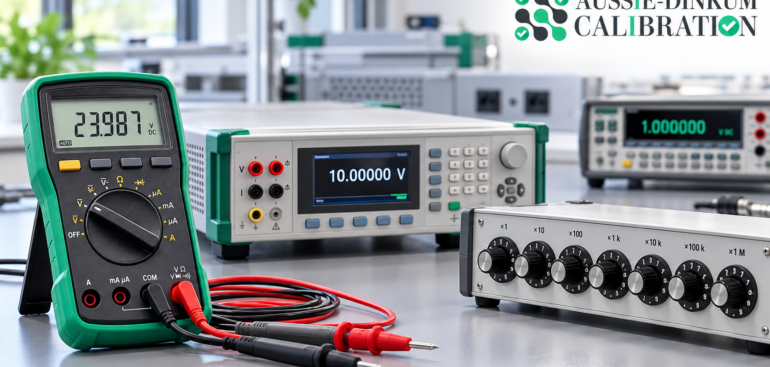
Electrical calibration services in Australia help businesses assess the performance of instruments used to measure voltage, current, resistance and other electrical quantities. However, a useful calibration starts with clearly defining what the instrument needs to measure.
A digital multimeter may offer several functions and measurement ranges, but your business might use only some of them. Another instrument may operate across several ranges, with particular readings used to make important quality decisions.
Defining the required functions, ranges and calibration points helps ensure the service reflects how your equipment is actually used. It also gives the calibration provider the information needed to assess whether its capabilities meet your requirements.
Why Is Defining the Measurement Range Important?
An instrument’s maximum measurement capability does not fully describe its calibration requirements.
For example, a multimeter capable of measuring up to 1,000 V may mainly be used to check 12 V and 24 V DC control circuits. A calibration covering unrelated functions or values may provide limited information about those everyday measurements.
The calibration request should identify the relevant functions, instrument ranges and operating values.
Key Benefits:
- Relevant Calibration Results: Selected points provide information about the measurements your business relies on.
- Clearer Service Requirements: The laboratory can understand the work required before preparing a quotation.
- Better Equipment Assessment: Results help you assess performance against the tolerances relevant to your application.
- Fewer Coverage Gaps: A defined scope reduces the chance of overlooking an important function or operating value.
- Useful Calibration Records: Documentation connects the calibration performed with the instrument’s intended use.
What Does Measurement Range Mean in Electrical Calibration?
A measurement range describes the interval of values an instrument can measure using a particular function or setting.
For example, a digital multimeter may have separate DC voltage ranges with upper limits such as 6 V, 60 V and 600 V. The available ranges depend on the instrument model.
Three related terms are useful when planning calibration:
1. Instrument Range
The instrument range is the selected measurement setting or internal range used to obtain a reading.
A 24 V DC measurement might use a 60 V range on a particular multimeter.
2. Operating Range
The operating range describes the values your business measures in practice.
For example, a maintenance team may regularly check DC voltages between 10 V and 30 V.
3. Calibration Points
Calibration points are the specific values assessed during calibration.
For that maintenance application, the laboratory might consider points around commonly measured values, alongside other points needed by the applicable procedure.
These terms should be recorded separately. Stating “calibrate up to 600 V” does not explain which instrument ranges, operating values or individual points matter.
Common Electrical Measurement Functions to Consider
Before selecting measurement ranges, identify the functions your equipment performs.
- DC Voltage: Used for measurements involving batteries, DC power supplies and control circuits.
- AC Voltage: Used for alternating voltage measurements, where frequency may also affect performance.
- DC Current: Used to assess direct current in electronic circuits and process signals.
- AC Current: Used for alternating current measurements, including suitable clamp-meter applications.
- Resistance: Used to measure resistors and other components within the instrument’s capability.
- Capacitance: Used to assess capacitors where this function is available.
- Frequency: Used to measure signal frequency.
- Electrical Power: Used by suitable instruments to measure quantities such as active power.
NATA electrical calibration scopes distinguish between measurement quantities and capabilities. This makes it important to check coverage for the specific function you need.
How to Define the Measurement Ranges You Need
Start with the instrument’s intended use, then compare your requirements with its specifications and the calibration provider’s capabilities.
1. Identify the Instrument
Record enough information to identify the equipment accurately.
Include:
- Instrument type.
- Manufacturer and model.
- Serial number or asset number.
- Relevant accessories.
- Functions used.
- Previous calibration certificate, if available.
Accessories can affect the measurement setup. For example, an external current clamp or probe may need to be included in the agreed calibration scope.
2. Review Everyday Measurements
Ask the people who use the instrument which quantities and values they measure.
Useful questions include:
- What are the lowest and highest values normally measured?
- Which readings are checked most frequently?
- Are measurements taken close to a product or process acceptance limit?
- Which functions are used to approve work or release products?
- Are any measurements only taken occasionally but still important?
A written procedure or equipment-use record can provide more reliable information than assumptions based on the instrument’s maximum capability.
3. Identify the Instrument Ranges Used
Check the instrument manual to determine which ranges apply to your operating values.
Two measurements using the same function may use different internal ranges. Performance on one range does not automatically establish performance on another.
For instruments with automatic range selection, discuss how the laboratory will identify and assess the relevant ranges.
4. Select Appropriate Calibration Points
Discuss point selection with the calibration provider.
Depending on the application and calibration method, points may be selected to assess:
- Common operating values.
- Relevant lower and upper values.
- Multiple instrument ranges.
- Values near important acceptance limits.
- Positive and negative values, where applicable.
- Points required by a manufacturer’s procedure or another applicable method.
There is no single set of calibration points suitable for every electrical instrument. A fixed percentage-based approach may overlook important operating values or instrument characteristics.
5. Include Frequency for AC Measurements
For AC voltage and AC current, the signal frequency can be an important part of the calibration requirement.
A request for “AC voltage calibration” may be incomplete if the instrument is used at different frequencies.
Specify the relevant combinations, such as:
- AC voltage at the frequencies used in your application.
- AC current at the applicable operating frequencies.
- Additional frequencies needed for electronic testing.
Also discuss waveform characteristics where relevant. Calibration using a sinusoidal signal may not fully represent measurements involving distorted waveforms.
6. Define the Required Tolerance
Tolerance describes the acceptable measurement error for the instrument or application.
The requirement may come from:
- Manufacturer specifications.
- Internal measurement procedures.
- Customer requirements.
- Product acceptance limits.
- Applicable technical requirements.
Electrical instrument specifications may combine a percentage of reading with an additional term, such as counts or a percentage of range. Provide the complete specification and its applicable conditions.
7. Discuss Measurement Uncertainty
The laboratory’s measurement uncertainty should be suitable for assessing the required tolerance.
An instrument used for general troubleshooting may need different calibration capability from one used to assess a tightly specified electrical reference.
Ask the provider about achievable uncertainty at your required points. Do not assume that one uncertainty value applies across every function and range.
A Practical Example of Defining Calibration Requirements
Suppose a business uses a digital multimeter for the following activities:
- Checking 12 V and 24 V DC supplies.
- Measuring a 4–20 mA DC process signal.
- Checking resistors around 100 Ω and 1 kΩ.
A useful calibration request would identify these functions and operating values, together with the relevant instrument ranges and tolerance requirements.
Example Request:
“Please propose calibration coverage for this multimeter’s DC voltage, DC current and resistance functions. Our main operating values are 12 V and 24 V DC, 4–20 mA DC, and resistance values around 100 Ω and 1 kΩ. Please confirm the instrument ranges, recommended calibration points, achievable uncertainty and applicable acceptance criteria.”
These are illustrative requirements. The final points should be agreed with the provider after reviewing the instrument and measurement procedure.
If AC voltage is also used, add its voltage and frequency requirements explicitly.
Should You Calibrate Every Function and Range?
The appropriate coverage depends on the instrument’s intended use and any applicable requirements.
Broader calibration may be appropriate when:
- Several teams use the instrument for different tasks.
- Most available functions are used.
- Future use is difficult to predict.
- A procedure or customer requires specified coverage.
- The instrument serves as a reference for other equipment.
Limited coverage may be appropriate when the instrument has a clearly controlled purpose.
If only selected functions or ranges are calibrated, document those limitations. Users should be able to distinguish the calibrated coverage from other available instrument functions.
How to Check a Calibration Provider’s Capability
A provider’s ability to calibrate one electrical quantity does not establish its capability for every quantity, range or instrument.
Before booking, discuss:
- Required electrical functions.
- Measurement ranges and points.
- AC frequency requirements.
- Required uncertainty.
- Relevant accessories and connections.
- Laboratory or on-site service requirements.
- Traceability and certificate requirements.
- Any requested conformity statement.
Where NATA-accredited calibration is required, check the relevant facility’s current scope against the work requested. Published scopes describe particular electrical measurement capabilities and associated conditions.
What Should Be Included in Your Calibration Request?
A clear request helps the provider propose suitable coverage and identify any limitations before work begins.
Calibration Request Checklist:
- Equipment Identification: Manufacturer, model, serial number and asset number.
- Intended Use: A short explanation of the measurements performed.
- Required Functions: Such as DC voltage, AC current or resistance.
- Operating Values: The values normally measured.
- Instrument Ranges: Relevant settings, where known.
- Calibration Points: Requested points or a request for the provider to recommend them.
- Frequency Requirements: For relevant AC measurements.
- Tolerance Limits: Complete specifications and applicable conditions.
- Uncertainty Requirements: Where your measurement procedure specifies them.
- Accessories: Probes, clamps, leads or other components included in the measurement.
- Reporting Requirements: Results, uncertainty and any requested pass or fail statement.
- Adjustment Instructions: Whether adjustment is authorised and whether results before and after adjustment are required.
Common Mistakes When Selecting Measurement Ranges
1. Providing Only the Instrument’s Maximum Value
The maximum value does not identify the functions, internal ranges or operating points that need assessment.
Provide information about how the instrument is used.
2. Leaving Out Frequently Used Functions
A multimeter calibrated for voltage alone may still be used for current or resistance measurements.
Check actual workplace use before confirming the scope.
3. Ignoring AC Frequency
An AC measurement requirement should include relevant frequency information.
Instrument performance may differ across frequency and amplitude combinations.
4. Assuming One Point Covers the Entire Range
A result at one point establishes information about that point under the calibration conditions.
It does not, by itself, demonstrate performance across every value or range.
5. Confusing Range with Accuracy
A wide measurement range does not necessarily mean an instrument can meet a demanding tolerance.
Range, resolution, measurement error and uncertainty describe different aspects of measurement performance.
6. Treating Calibration as Automatic Adjustment
Calibration and adjustment are separate activities.
Clarify whether adjustment is required and whether the provider should report the instrument’s condition before any changes are made.
How to Review the Calibration Certificate
When the instrument returns, compare the certificate with the agreed request.
Check:
- The correct instrument identification.
- Functions and ranges assessed.
- Calibration points and units.
- Frequencies used for AC measurements.
- Reported indications, errors or corrections.
- Measurement uncertainty and its explanation.
- Relevant calibration conditions.
- Any adjustment performed.
- Limitations or excluded functions.
If the certificate includes a pass or fail statement, review the acceptance criteria and decision rule used.
Resolve missing coverage before relying on the instrument for the affected measurements.
When Should Your Calibration Requirements Be Updated?
Review the scope when the instrument’s use changes.
Relevant triggers include:
- New products or processes.
- Different operating voltages or currents.
- Tighter measurement tolerances.
- Additional functions being used.
- New probes or accessories.
- Changes to customer requirements.
- Equipment repair or modification.
A previous calibration request can be a useful starting point, but it should be checked against current needs.
Final Thoughts
Defining measurement ranges is an important part of arranging electrical calibration services in Australia.
Start by identifying the quantities your equipment measures, the instrument ranges used and the operating values that matter. Then agree on suitable calibration points, frequencies, tolerances and uncertainty with the provider.
Clear requirements help ensure the calibration results support the decisions your business needs to make.