
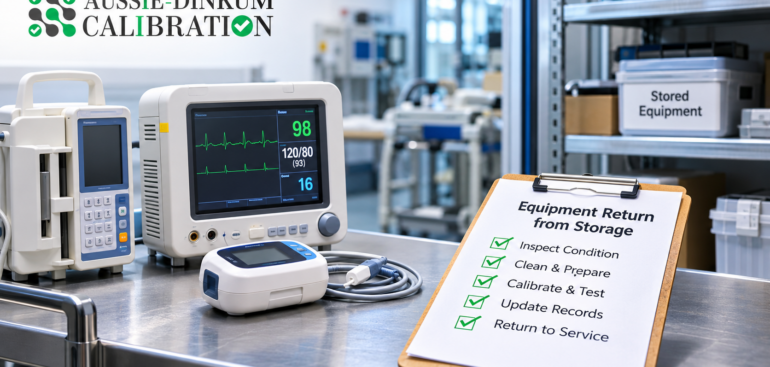
Medical equipment calibration in Perth helps healthcare facilities verify the measurement performance of instruments used for patient monitoring, diagnosis and clinical procedures.
Medical equipment that remains in storage for several weeks or months may be exposed to dust, humidity, temperature changes or accidental physical damage. Even when equipment appears to be in good condition, its measurement performance and operational suitability should be checked before it returns to clinical use.
When discussing stored medical equipment with Aussie Dinkum Calibration, start with the equipment list, storage history, previous calibration certificates and planned return-to-service date. These details help you identify the required checks and organise calibration before equipment is used again.
Why Should Medical Equipment Returning From Storage Be Managed?
Medical equipment may not be used regularly, but storage does not automatically guarantee that its measurement performance remains acceptable. Environmental conditions, ageing components, battery deterioration and handling damage can affect equipment condition.
A structured return-to-service process helps healthcare facilities identify equipment problems, review calibration status and confirm that instruments are suitable for their intended clinical applications.
Managing Stored Medical Equipment Helps Healthcare Facilities
- Identify equipment that has remained unused for extended periods.
• Check whether calibration certificates are still within their required validity periods.
• Identify possible damage caused by storage conditions.
• Inspect sensors, probes, cables and accessories before use.
• Arrange calibration when required by the equipment’s maintenance programme.
• Confirm that equipment meets operational and measurement requirements.
• Maintain accurate equipment history and service records.
• Reduce the risk of using unsuitable equipment in clinical environments.
1. Identify Medical Equipment Returning From Storage
Start by preparing a list of all medical equipment scheduled to return to service. Different instruments may have different inspection, maintenance and calibration requirements.
Use the equipment register to identify instruments that have been stored and confirm their intended clinical applications.
Equipment Details to Record
- Equipment type and manufacturer.
• Model number and serial number.
• Asset identification number.
• Department or clinical application.
• Date the equipment entered storage.
• Expected return-to-service date.
• Previous calibration date and certificate reference.
• Storage location and responsible department.
For example, a hospital in Perth may have several patient monitoring devices stored during a department renovation. Identifying each device separately helps the equipment coordinator organise inspection, maintenance and calibration before the devices return to clinical use.
2. Review Storage Conditions and Duration
Storage conditions can influence the condition of medical equipment. Temperature fluctuations, moisture, dust and unsuitable packaging may affect sensitive electronic components, sensors and accessories.
Review how the equipment was stored before arranging its return to service.
Storage Information to Check
- Total duration of storage.
• Storage room temperature and humidity conditions, where recorded.
• Whether the equipment was stored in its original packaging.
• Protection from dust and moisture.
• Whether equipment was exposed to direct sunlight.
• Battery storage and charging arrangements.
• Whether the storage area experienced water leaks or environmental incidents.
• Any movement or handling during storage.
If equipment was stored in an area with uncontrolled humidity, arrange an appropriate inspection before returning it to clinical use. Follow the manufacturer’s instructions for environmental exposure and storage conditions.
3. Review Previous Calibration Certificates and Service Records
Before arranging calibration, review the equipment’s previous calibration certificates and maintenance history. This helps determine whether the equipment is due for calibration and whether any earlier issues need attention.
A calibration certificate provides information about the instrument’s measurement performance at the time of calibration. However, it does not automatically confirm that equipment remains suitable after an extended storage period.
Records to Review
- Previous calibration certificate and reference number.
• Last calibration date.
• Next calibration due date.
• Previous measurement results.
• Earlier results outside tolerance.
• Maintenance and repair history.
• Manufacturer service recommendations.
• Any restrictions recorded before storage.
For example, if a patient monitoring device was due for calibration during its storage period, the equipment coordinator should review its calibration status before approving it for use. Arrange the required service according to the applicable equipment and quality procedures.
4. Inspect Equipment and Accessories Before Powering On
Perform an initial visual inspection before reconnecting or operating stored medical equipment. Equipment may develop visible problems during storage even when its external appearance initially seems acceptable.
Follow the manufacturer’s instructions and applicable healthcare facility procedures when carrying out these checks.
Inspection Details to Confirm
- Equipment casing and external surfaces show no obvious damage.
• Displays, buttons and control panels are in suitable condition.
• Power cables and electrical connections show no visible damage.
• Sensors, probes and patient cables are present.
• Connectors and terminals are clean and undamaged.
• Batteries show no visible swelling or leakage.
• Accessories are compatible with the equipment.
• Labels and equipment identification remain readable.
If equipment shows signs of physical damage, moisture exposure or electrical problems, keep it out of service until it has been assessed by an appropriately qualified person.
5. Check Battery Condition and Electrical Safety
Medical equipment may rely on rechargeable batteries or external power supplies. During extended storage, batteries can lose charge or deteriorate depending on their chemistry, age and storage conditions.
Check the power system before conducting operational testing.
Battery and Electrical Checks to Consider
- Battery condition and visible signs of deterioration.
• Battery charging performance.
• Power supply and charging cable condition.
• Electrical connections and connectors.
• Equipment power-on behaviour.
• Manufacturer-recommended battery replacement requirements.
• Applicable electrical safety inspection requirements.
• Any unusual heating, warning messages or power interruptions.
For example, a portable patient monitoring device may switch on but lose power quickly because its battery deteriorated during storage. The battery issue should be addressed before the equipment is returned to clinical use.
6. Arrange Calibration and Functional Testing Where Required
After reviewing equipment condition and previous records, determie whether calibration or functional testing is required before the equipment returns to service.
Different medical instruments require different assessment procedures depending on their measurement functions and intended applications.
Calibration and Functional Testing Requirements to Review
- Equipment measurement functions.
• Required measurement ranges.
• Manufacturer calibration recommendations.
• Previous calibration due dates.
• Internal maintenance and quality requirements.
• Functional testing requirements.
• Applicable acceptance criteria.
• Required calibration documentation.
For example, a medical temperature monitoring instrument returning from long-term storage may require its measurement performance to be checked against the relevant reference points. The required calibration scope should be confirmed before the service is arranged.
7. Manage Equipment Found Outside Tolerance or With Faults
During inspection or calibration, some equipment may show measurement deviations, operational problems or signs of deterioration. Healthcare facilities should have a clear procedure for handling these findings.
Do not assume that equipment can return to clinical use simply because it powers on successfully.
Actions to Take
- Keep equipment with unresolved problems out of clinical service.
• Record the issue and date of discovery.
• Notify the biomedical engineering or equipment management team.
• Arrange appropriate inspection, repair or calibration.
• Review as-found calibration results where applicable.
• Check whether earlier clinical measurements could be affected.
• Arrange replacement equipment if required.
• Document corrective actions and approval before returning equipment to service.
If a monitoring instrument produces results outside its applicable acceptance limits, the responsible technical team should assess its suitability and determine whether further investigation is necessary.
8. Update the Equipment Register Before Returning It to Service
Once inspection, maintenance and calibration requirements have been addressed, update the equipment register with the latest information.
This helps healthcare facilities maintain accurate records and identify the condition and service status of each instrument.
Information to Update
- Equipment identification and serial number.
• Storage start and return dates.
• Inspection completion date.
• Calibration certificate reference.
• Calibration results and relevant limitations.
• Maintenance or repair details.
• Battery or accessory replacement details.
• Equipment approval status.
• Next calibration due date.
• Responsible reviewer or authorised person.
Keep earlier records rather than replacing them. This provides a history of equipment condition, storage periods and completed maintenance activities.
A Practical Medical Equipment Return-from-Storage Checklist
| Review item | What to check |
| Equipment identification | Manufacturer, model, serial number and asset ID |
| Storage history | Storage duration and environmental conditions |
| Previous records | Calibration certificates and maintenance history |
| External condition | Casing, display, controls and connectors |
| Accessories | Sensors, probes, cables and attachments |
| Battery condition | Charging, deterioration and replacement requirements |
| Electrical safety | Applicable inspection and testing requirements |
| Calibration | Due dates, scope and required measurement points |
| Functional testing | Operational performance and equipment functions |
| Fault management | Damage, repairs and results outside tolerance |
| Documentation | Updated register and calibration records |
| Return approval | Review and authorisation before clinical use |
Hypothetical Example: Returning Stored Medical Equipment to Service at a Perth Hospital
A Perth hospital stores several patient monitoring devices during a ward renovation. After the renovation, the biomedical engineering team prepares to return the devices to their original departments.
During the initial review, the team identifies different storage periods and notices that one device has a calibration due date approaching.
Example Review
- Before inspection — The biomedical team prepares an equipment list with serial numbers and previous calibration records.
- Storage review — The team checks the storage area, packaging and available environmental records.
- Physical inspection — Each device is checked for visible damage, battery condition and missing accessories.
- Calibration planning — The team identifies instruments requiring calibration or additional technical assessment.
- Report review — Calibration results and functional testing records are checked against the applicable requirements.
- Return to service — The responsible team updates the equipment register and approves suitable equipment for clinical use.
This process helps the hospital maintain equipment traceability and avoid returning instruments to clinical departments without completing the required checks.
How to Prepare Medical Equipment for Medical Equipment Calibration in Perth
Prepare the equipment list before requesting a calibration quote. Include the medical instruments returning from storage and explain their applications, previous service history and expected availability.
Suggested Preparation Steps
- List the equipment — Record the manufacturer, model, serial number and asset identification.
- Describe the application — Explain how each instrument is used in the healthcare facility.
- Provide storage details — Share the storage duration and any known environmental conditions.
- Review previous records — Collect calibration certificates, maintenance history and previous service reports.
- Identify accessories — List sensors, probes, cables and other equipment supplied with each instrument.
- Describe known issues — Flag battery deterioration, physical damage or unusual operational behaviour.
- Confirm calibration requirements — Identify measurement functions, ranges and applicable acceptance criteria.
- Plan equipment availability — Share the required completion dates and arrangements for replacement equipment.
- Confirm the quotation scope — Check calibration coverage, exclusions and expected turnaround before booking.
Review the Calibration Report Before Returning Equipment to Clinical Use
Compare the calibration report with the agreed requirements and the instrument’s intended application. Check that the report identifies the correct equipment and covers the required measurement functions.
Check the Following
- Instrument model and serial number.
• Calibration date and certificate reference.
• Measurement functions and ranges assessed.
• Calibration points and reported results.
• Measurement uncertainty and any conformity statement, where applicable.
• Results before and after adjustment, where requested.
• Any limitations or observations recorded by the provider.
• Whether the results meet the applicable acceptance criteria.
• Any additional inspection or maintenance requirements.
• Updated equipment status and next calibration due date.
Record the review in the equipment register and ensure that the responsible healthcare facility team completes the required return-to-service approval before clinical use.
Common Mistakes to Avoid
Returning Equipment to Use Without Reviewing Storage History
Check how long the equipment remained stored and whether the environmental conditions could have affected its condition.
Assuming a Valid Calibration Sticker Confirms Equipment Suitability
Review the calibration certificate and inspect the instrument before returning it to service.
Ignoring Battery and Accessory Deterioration
Check batteries, sensors, probes and cables because these components may deteriorate during storage.
Skipping Functional Testing
Confirm that equipment operates correctly and completes the applicable functional checks before clinical use.
Overlooking Previous Calibration Issues
Review earlier results outside tolerance and confirm whether corrective actions were completed.
Failing to Update Equipment Records
Record the inspection, calibration, maintenance and approval details in the equipment register.
Returning Equipment Without Authorised Approval
Ensure that the responsible technical or clinical equipment management team reviews the completed requirements before the equipment returns to service.
Working With Aussie Dinkum Calibration for Perth Requirements
When discussing medical equipment calibration in Perth with Aussie Dinkum Calibration, explain which instruments are returning from storage and when the equipment needs to be available again. A clear request helps the provider understand the equipment requirements and confirm the calibration scope it can support.
Information to Discuss With the Calibration Provider
- Medical equipment types, models and quantities.
• Instrument serial numbers and asset identification.
• Measurement functions and required ranges.
• Storage duration and known environmental exposure.
• Previous calibration certificates and service history.
• Known equipment faults or previous results outside tolerance.
• Applicable acceptance criteria and reporting requirements.
• Relevant accessories and configurations.
• Calibration turnaround and equipment handover arrangements.
• Perth service availability and any onsite requirements.
Final Thoughts
Managing medical equipment returning from storage requires more than checking whether an instrument switches on. Review its storage history, inspect its physical condition, check accessories and batteries, and confirm whether calibration or functional testing is required.
Keep calibration certificates and maintenance records updated before returning equipment to clinical use. A consistent return-to-service process helps healthcare facilities maintain equipment traceability, support measurement reliability and make informed decisions about equipment suitability.