
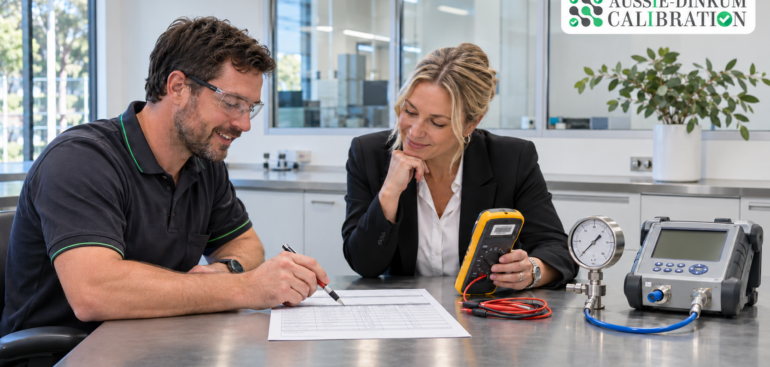
A calibration company in Adelaide needs clear information about your equipment and measurement requirements to understand the service you are requesting.
Providing an instrument’s model and serial number is a useful starting point. However, these details do not explain which measurement errors are acceptable for your application or how you want conformity assessed.
For businesses discussing their requirements with Aussie Dinkum Calibration, communicating acceptance criteria before calibration helps clarify the required measurement points, applicable tolerances and reporting expectations.
Why Should Acceptance Criteria Be Discussed Before Calibration?
Calibration establishes information about an instrument’s measurement performance. A statement that the instrument passes or fails requires a defined specification and a method for assessing the results against it.
When a conformity statement is requested, the specification and decision rule need to be clearly defined. Unless the rule is already inherent in the requested specification or standard, it should be communicated to and agreed with the customer. European Accreditation
Communicating Acceptance Criteria Helps Businesses:
- Identify the specifications relevant to the instrument.
• Explain the measurement requirements of the application.
• Confirm the calibration points and working ranges.
• Clarify whether a conformity statement is required.
• Discuss how measurement uncertainty affects the assessment.
• Establish reporting requirements before work begins.
• Define what should happen if results exceed the agreed limits.
• Maintain consistent records for future calibration reviews.
The aim is to ensure that the requested calibration provides information the business can use when deciding whether equipment is suitable for its intended task.
1. Explain the Measurement Task and Intended Use
Start by describing what the instrument measures and how your team uses its readings.
Equipment used for general monitoring may have different requirements from equipment used to accept finished products or control a sensitive production process.
Application Details to Provide:
- Quantity being measured.
• Measurement units.
• Normal operating range.
• Important operating points.
• Products or processes being checked.
• Decisions made using the readings.
• Relevant operating conditions.
• Consequences of an incorrect measurement.
Explain any restrictions on the equipment’s use. For example, an instrument with a wide measurement range may only be approved for a smaller working range within your business.
2. Identify the Source of the Acceptance Criteria
Acceptance criteria should have an identifiable basis. Depending on the application, this may involve manufacturer specifications, customer requirements, an applicable standard or an approved internal procedure.
Provide the relevant document and revision so the calibration provider can identify the requirements you intend to apply.
Sources to Review:
- Manufacturer’s accuracy specifications.
• Equipment manuals and technical data sheets.
• Customer contracts or quality requirements.
• Applicable measurement standards.
• Relevant regulatory requirements.
• Approved internal equipment procedures.
• Engineering specifications.
• Documented application requirements.
Avoid using an old calibration certificate as the only source without checking whether its criteria remain appropriate.
Where requirements differ between documents, resolve the difference with the responsible quality or technical person before confirming the calibration request.
3. State Tolerances Clearly With Units and Conditions
A request such as “check that the instrument is accurate” does not provide a measurable acceptance requirement.
State the permitted error, relevant units and the conditions under which the specification applies. If tolerances vary across the range, explain which limit applies at each point.
Details to Confirm:
- Lower and upper tolerance limits.
• Measurement units.
• Whether limits are absolute or percentage based.
• Whether a percentage applies to the reading, span or full scale.
• Any additional digits or counts in the specification.
• Relevant measurement range or instrument setting.
• Environmental conditions attached to the specification.
• Applicable document reference and revision.
For example, ±1% of reading and ±1% of full scale can produce different permitted errors. Provide the complete specification rather than shortening it to “±1%”.
Do not automatically use a product’s process tolerance as the instrument’s permitted error. The measurement equipment needs an appropriate capability for assessing that process.
4. Match Calibration Points to the Required Assessment
When contacting a calibration company in Adelaide, explain where the equipment normally operates and which points are important to your application.
Confirm whether the proposed calibration points provide the information needed for your intended assessment.
Simplified Example:
An Adelaide workshop uses a pressure gauge mainly at 200 kPa, 400 kPa and 600 kPa.
The workshop provides these operating points and the approved equipment tolerance when requesting calibration. It also asks the provider to confirm whether additional points or increasing and decreasing pressure readings are appropriate.
Calibration Scope Details to Record:
- Measurement functions.
• Required ranges.
• Calibration points.
• Units and display settings.
• Increasing or decreasing measurement direction, where relevant.
• Probes, sensors and channels.
• Equipment configuration.
• Acceptance criteria applicable to each function.
If only part of an instrument’s capability is assessed, ensure that this limitation is clear in the records and any approval for use.
5. Discuss Measurement Uncertainty and the Decision Rule
Measurement uncertainty describes the uncertainty associated with a reported measurement result. A decision rule explains how that uncertainty is considered when deciding conformity with a specified requirement.
Ask the provider to explain the proposed rule, particularly how results close to a tolerance limit will be assessed. ILAC guidance recommends agreeing and documenting the rule before work begins. nab.lrv.lt
Questions to Discuss:
- Is a conformity statement included in the requested service?
• Which specification will the assessment use?
• What decision rule is proposed?
• How does the rule consider measurement uncertainty?
• Does the rule use a guard band?
• How will results close to a limit be reported?
• What outcomes can appear on the certificate?
• Does the proposed approach meet applicable customer requirements?
Keep the agreed explanation with the calibration request so the person reviewing the completed report can understand the assessment.
6. Confirm Whether a Conformity Statement Is Required
Explain whether you require measurement results alone or a statement assessing those results against specified requirements.
If you request a conformity statement, identify the functions, ranges and results it should cover. Avoid assuming that one overall status applies to every capability of a multifunction instrument.
Reporting Requirements to Confirm:
- Numerical calibration results.
• Reported errors or corrections.
• Measurement uncertainty.
• Applicable specifications.
• Conformity statement, where requested.
• Identification of the assessed results.
• Decision rule used.
• Limitations or exclusions.
The business should still review the report against the intended application before authorising equipment for use.
7. Agree on Adjustment and Out-of-Tolerance Instructions
Tell the provider what to do if the equipment exceeds the agreed criteria or appears to need adjustment.
Calibration and adjustment are different activities. Confirm whether adjustment is authorised, whether approval is required first and what information you need about the instrument’s condition before any changes.
Instructions to Agree:
- Whether adjustment is permitted.
• Who can authorise additional work.
• Whether results before adjustment are required.
• Whether results after adjustment are required.
• When the provider should contact your team.
• Whether repairs require a separate quotation.
• How unsuccessful adjustment should be reported.
• What to do if the requested scope cannot be completed.
Results recorded before adjustment can help your business assess whether earlier measurements require investigation.
Do not assume that every calibration service automatically includes repair, adjustment or both sets of results.
8. Record the Agreement Before Work Begins
Keep the acceptance criteria and reporting instructions in a written record that both parties can reference.
Use an approved request form, quotation acceptance, purchase order attachment or another controlled document. Check that the provider has acknowledged the relevant requirements.
Information to Record:
- Instrument identification.
• Requested functions and ranges.
• Calibration points.
• Specification source and revision.
• Tolerance limits and units.
• Agreed decision rule.
• Required reporting details.
• Adjustment instructions.
• Responsible contact person.
• Date and reference of the agreement.
If requirements change, communicate the update promptly and confirm its effect on the service before the affected work proceeds.
A Practical Acceptance Criteria Communication Checklist
| Review item | What to communicate |
| Equipment identity | Manufacturer, model, serial number and asset number |
| Intended application | Measurement task and decisions supported |
| Working range | Normal operating range and approved uses |
| Calibration points | Required points, functions and measurement direction |
| Specification source | Applicable document, section and revision |
| Tolerance limits | Permitted errors, units and calculation basis |
| Associated components | Probes, sensors, leads, adapters and channels |
| Decision rule | Agreed approach to assessing conformity |
| Reporting requirements | Results, uncertainty and any conformity statement |
| Adjustment instructions | Approval requirements and before-and-after results |
| Contact person | Person authorised to resolve technical questions |
| Written confirmation | Acknowledged scope and acceptance requirements |
Hypothetical Example: Agreeing on Temperature Instrument Criteria in Adelaide
An Adelaide manufacturer uses a digital temperature indicator with a dedicated probe to monitor a heating process.
Before arranging calibration, the quality team reviews the equipment’s approved use and prepares a written request covering the complete indicator-and-probe combination.
Example Review:
- Measurement Purpose: The team identifies the temperatures used during production.
• Equipment Identification: Staff record the indicator and probe identification numbers.
• Acceptance Criteria: The responsible technical person confirms the approved instrument error limits.
• Calibration Points: The request lists points relevant to the working range.
• Decision Rule: The business discusses and agrees on the provider’s proposed conformity assessment approach.
• Adjustment Instructions: The provider must obtain approval before adjustment and confirm whether before-and-after results can be supplied.
• Report Review: The quality team checks the completed report before authorising continued use.
This example is illustrative. Actual limits, calibration points and decision rules depend on the equipment, application and applicable requirements.
How to Prepare Your Request for a Calibration Company in Adelaide
Collect the equipment information and acceptance requirements before requesting a quotation.
A complete request gives the provider a practical basis for reviewing the scope and identifying questions that need to be resolved.
Suggested Preparation Steps:
- Identify the Equipment — Record the manufacturer, model, serial number and asset number.
- Describe the Application — Explain what the instrument measures and how readings are used.
- Confirm the Specification — Provide the applicable document and revision.
- State the Tolerances — Include units, limits and any percentage calculation basis.
- List Measurement Points — Identify required functions, ranges and operating points.
- Discuss Conformity Reporting — Confirm whether a statement is required and agree on the decision rule.
- Set Adjustment Instructions — Explain approval requirements and the results needed.
- Obtain Written Confirmation — Check that the agreed scope reflects your request.
Allow time to resolve technical questions before the equipment is needed for production or inspection.
Review the Calibration Report Against the Agreed Criteria
Compare the completed report with the accepted service request.
Check that the equipment identification, calibration coverage and reported assessment match the agreed requirements.
Check the Following:
- Instrument and accessory identification.
• Measurement functions and ranges assessed.
• Requested calibration points.
• Numerical results and reported errors.
• Measurement uncertainty.
• Specification references.
• Any conformity statement and decision rule.
• Results before and after adjustment, where requested.
• Limitations and exclusions.
• Any unanswered questions affecting suitability for use.
Resolve discrepancies before approving the equipment. If results indicate a potential problem with earlier measurements, follow your internal process for assessing the affected work.
Update the equipment register and record any restrictions on use.
Common Mistakes to Avoid
Requesting a Pass Without Defining the Specification
Provide the applicable limits and their source so the requested assessment has a clear basis.
Using Percentage Limits Without Explaining the Basis
State whether the percentage applies to the reading, full scale or another defined value.
Treating Process Tolerance as Instrument Accuracy
Have the responsible technical person establish suitable measurement equipment requirements for the application.
Leaving the Decision Rule Until After Calibration
Discuss how conformity will be assessed before work begins, including the treatment of results close to a limit.
Overlooking Probes and Accessories
Identify the complete measurement setup and confirm which combinations the assessment covers.
Assuming Adjustment Is Automatically Authorised
Record approval requirements and confirm whether results before adjustment are needed.
Working With Aussie Dinkum Calibration for Adelaide Requirements
When discussing Adelaide calibration requirements with Aussie Dinkum Calibration, provide the intended application, equipment details and proposed acceptance criteria.
This information supports a clear discussion about the requested scope, reporting requirements and any technical details that need clarification.
Information to Discuss With the Calibration Provider:
- Instrument manufacturer, model and identification.
• Intended measurement application.
• Working ranges and calibration points.
• Applicable specifications and document revisions.
• Tolerance limits and units.
• Associated probes, sensors and accessories.
• Required conformity statement and decision rule.
• Adjustment and repair approval requirements.
• Required certificate details and applicable accreditation scope.
• Equipment availability and proposed service arrangements.
Confirm Adelaide service availability, applicable coverage and the proposed scope before booking.
Final Thoughts
Choosing a calibration company in Adelaide involves clearly explaining what your business needs to learn about its equipment.
Define the measurement application, provide the relevant specifications and state tolerances with their units and conditions. Agree on the required conformity assessment, reporting details and adjustment instructions before calibration begins.
Discuss your requirements with Aussie Dinkum Calibration and retain the written agreement with the completed report to support consistent equipment reviews.